Under the radar: offsetting cumulative, offsite, cryptic and secondary ecological impacts in intact landscapes

I spoke on the topic of offsets and how they are, and could be applied cumulative, offsite, cryptic and secondary ecological impacts in intact landscapes at the Ecological Society of Australia’s conference in Melbourne in December 2012.

My presentation formed part of the session on Environmental Management and Land Use along with those of Saul Cunningham, Hannah Pearson, Elizabeth Law, Kelly Hunt de Bie, Peter Curtis, and Keryn Paul. The session covered a wide range of topics on the interface of conservation science and management. The topics included biodiversity impacts of agriculture, modelling for improved land management, integrating ecosystem services into land-use planning, managing bush camps grounds, survival of native species under prescribed fire management regimes, biodiversity offsets for cumulative impacts, and carbon sequestration by environmental and mallee plantings.

I put forward the conceptual framework that I’ve designed together with my supervisors Richard Hobbs, Suzanne Prober and Hugh Possingham for my research. The abstract for my presentation follows:

Background/Question/Methods:

Surging worldwide interest in offsets holds the promise of addressing ongoing biodiversity decline caused by development projects. Offsets consist of conservation actions designed to compensate for deleterious impacts. While offsets are widely criticised, they are also an increasingly utilised, and therefore important, part of environmental conservation in the face of ongoing biodiversity decline.

We pose the question Can biodiversity offsets be used to allay the impacts of developments in relatively intact ecosystems? To answer this, we review the literature and present a framework for conceptualising impacts that generally pass under the radar of evaluations used to calculate environmental offsets, such as environmental impact assessments.

Results/Conclusions:

We present a set of case studies and examples that suggest that in order to achieve the purported goal of ‘no net loss’ in relatively intact systems, biodiversity offsets need to account for cumulative, offsite, cryptic, and secondary impacts to ecological values. Accounting for these impacts, however, is not straightforward: it may involve enhanced cumulative impact assessments that incorporate projected offsite, cryptic and secondary impacts; improved incorporation of precaution into decision-making processes; designating no-development zones; developing means for restricting human access to areas with development, environmental risk insurance, and strategically applying offsets to perform conservation actions that will most enhance the values of the region. Lastly, truly achieving positive environmental outcomes in relatively intact systems requires that offsets are used only within their rightful place in the ‘mitigation hierarchy’, with unacceptable impacts avoided, acceptable impacts minimised, and restoration planned, all before offsets are considered.

Award: 

I was awarded the Society for Conservation Biology Prize for a spoken paper on conservation, for this presentation. Thank you to the Society for Conservation Biology for sponsoring this prize.

Image

Posted in blog, research | Leave a comment

Conservation: are you in it for the long run?

Conservation: a marathon, not a sprint? pic from http://www.unionleader.com/
article/20120708/SPORTS10/707
099972

Yesterday I had a discussion with a friend who felt overwhelmed about the peril that nature, and biodiversity are in, and sceptical about the use of biodiversity offsets as a mechanism to deal with some of it. The ecological crisis is deepening[1] as we sleep, eat and breathe, and most of the threatening factors seem only to be amplifying and expanding… habitat loss, fragmentation and degradation; exotic species invasions, pollution; climate change; overhunting; and overpopulation combined with unsustainable consumption. What did I think? I’m interested in the long term.

Last week, I met a wise man who’s son worked with the United Nations in the Middle East. His manager was the world-famous social rights activist and winner of the Nobel Peace Prize (and countless others), Desmond Tutu. Their mission was to promote an end to the conflicts and create peace between the Israelis and the Palestinians.

After some time on the job, this man’s son approached Desmond Tutu and told him that he could no longer work there. He was overwhelmed by the difficulty of the mission. As he came to understand the complexity of the conflicts, how deeply entrenched and multi-layered, and wicked[2] the problems were, he lost faith in the mission’s hopes of promoting peace. As an Israeli who has lived through some of the conflicts and who has taken a keen interest in trying to figure out what went wrong and what we can do about it, I sorely empathized.

And so did Desmond, but he had a larger lens to look through. ‘I like to think of the timeframe for our mission as being five thousand years. We may not achieve peace this year, or even in fifty years, but I think we have a chance over the next 5000’.

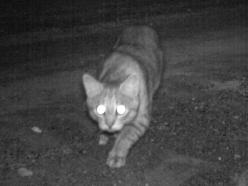
These cute creatures wreak havoc on native mammal, reptile and bird populations. Predation by feral cats (along with foxes), is a key threatening process under Australia’s Environment Protection and Biodiversity Conservation Act 1999. And they are almost impossible to eradicate. Photograph taken by motion-sensor camera © Keren Raiter, October 2012.

Which brings us back to the ecological crisis, and the other crises unfolding around us[3]. There is plenty to worry about, and solutions are not being applied as quickly, or as well, as they could be, where they exist at all.

But we must appreciate how far we’ve come. Environmental practices across the globe have in most cases improved, and in many cases transformed altogether. Governments now have a suite of laws providing some sort of protection to parts of the environment; something that was unheard of only 200 years ago. Mining practices are far more considerate for the environment than they were even 50 years ago.

Disregarding political and economic fluctuations, there is far more interest and impetus (and money) for conservation in the area now than there was even 100 years ago, from governments, NGOs, the private sector, and philanthropists. In some areas (such as the Great Western Woodlands), the indigenous people are more empowered and closer to gaining recognition of native title and contributing to conservation than they were only 50 years ago (albeit still shockingly less they were 2000 years ago). And offsets? they’re far from perfect, but at least they’re on the table, unlike just 30 years ago. And in 500 years (or perhaps sooner) we may get them right.

Looking beyond this year, the next election, the latest buzzword for ‘saving the earth’; beyond my lifetime and yours… there will be something there in 5000 years time; and we play a part in determining what it will be.


[1] eg: World leaders failed to deliver on commitments made in 2002 to reduce the global rate of biodiversity loss by 2010, and have instead overseen alarming biodiversity declines (http://www.iucn.org/media/media_advisories/?5140/World-governments-fail-to-deliver-on-2010-biodiversity-target).

[2] eg the article http://theconversation.edu.au/wicked-problems-and-business-strategy-is-design-thinking-an-answer-6876 discusses wicked problems

[3] actually this post was inspired by a challenging discussion I had with a friend about something they saw as being a major crisis, and that I saw as difficult, but good in the long run.

Posted in blog | 1 Comment

The world below the blue: conservation input closes today

The world’s rich marine resources are vastly under-protected, in the face of massive, growing exploitation, and increasing pollution, entanglement in nets, destruction of important habitat  and other impacts from various human activities, and the global changes that result. Australia risks joining the unprecedented global collapse of marine life where two-thirds of the world’s coral reefs are dead or dying and 90% of the world’s large fish have been fished-out¹. But Australia still has a lot that can be protected. This video shows a sequence of video footage captured off Perth, Western Australia by the Oceans institute, University of Western Australia.

According to Save our Marine Life, Australians claim the third largest area of ocean on Earth and have an international responsibility to conserve our oceans. The Commonwealth Government signed the United Nation’s Convention on the Law of the Sea to manage the oceans surrounding our continent for both economic benefit and conservation. However, only four per cent of our 16.5 million square kilometres of oceans around Australia are protected, despite many of our marine species being found nowhere else.

But this is changing. In response to calls for greater marine protection, Australia has been developing a system of marine reserves with input from across the nation and a wide variety of stakeholder groups. As would be expected, there were many debates about the implications of the approaches and solutions proposed, with strong voices heard from recreational fishers, fisheries industries, and conservation groups. I was saddened to see some attempts from recreational fisheries interests to paint bleak pictures of proposed sanctuaries with ads that showed kids dressed in bathers² and stuck behind a fence, unable to access the beach. This legislation is not about locking off all beaches from people – it is about ensuring that there is still something there for our kids to see (and eat, and gain a plenitude of benefits from in perpetuity).  However I don’t believe that this advertisement correctly reflects most recreational fishers, as most are aware that protected areas are highly beneficial for fish diversity and numbers, and fishing next to a protected area is much more fruitful than fishing next to an area decimated by unsustainable practices.

The debates surrounding the development of the new network of marine protected areas also saw historic engagement by people who think that marine protected areas are positive, and essential, with Save Our Marine Life and The Big Blue Army leading campaigns, including  40,000 submissions in support of marine sanctuaries (a new record for public consultation on a conservation issue).

The final proposal is currently up for comments, with comments closing tonight. While not perfect, this proposal offers unprecedented protection to our incredible marine ecosystems, and has proved to be the most popular decision made by the current government, according to Sky News.  It includes some of the most important areas for southern right, blue and humpback whales (including one of three humpback calving hotspots in the northwest), unique species of giant barracuda, marlin and sharks; endangered loggerhead turtles fish, and prevention of destructive gillnetting and sea floor trawling in many areas.

The final proposal is currently up for comment, and comments close tonight. Today you have a great opportunity to add strength to the push to protect our marine heritage. You needn’t be Australian to contribute either – Australia is simply the custodian of heritage that belongs to the whole world, that is valuable is its own right regardless of country borders, and that everyone in the world may benefit from in some way or another – whether it is by visiting Australia and enjoying it with your own eyes, seeing it in documentaries or learning about it in school, enjoying a climate that is partly stabilised by the contribution that these ecosystems make to carbon sequestration, using medicines or therapies that are derived from these ecosystems, or eating fish or other seafood from these areas – in this generation and in those to follow.

If you would like to sign the petition to approve the current plan for marine protected areas, simply go to: www.saveourmarinelife.org.au/sos and scroll down a little to where you can enter your details, and press SEND.

More information is available from the Government website at www.environment.gov.au/coasts/mbp/reserves/ or from the Save Our Marine Life website.

¹ I have heavily referenced saveourmarinelife.org.au here.            ² ‘bathers’ is Australian English for ‘bathing suit’ or ‘swimming costume’.

Posted in blog, sustaining ecology | Tagged , , , , , | Leave a comment

Threatened species day: for those we remember, for those we never knew, and for those who still stand a chance

Today we commemorate the death of the last known Thylacine (also called the Tasmanian Tiger or Tasmanian Wolf) in 1936. It is national threatened species day, held each year on 7th September.

The Thylacine once lived all across Australia and New Guinea and was Australia’s largest predator, but was wiped out from the mainland around 3500 years ago; soon after the dingo was introduced and human (Aboriginal) populations grew in size and started using more sophisticated technology, explain Mark Letnic and others in a recent paper. Thylacines survived in Tasmania where there were no dingoes until the early 1900s, when they were wiped out by hunting (a bounty was even offered by the Tasmanian Government and the Van Diemen’s Land company on their heads).

Without the integral role of top-order predator being filled by the Thylacine, dingoes now play an integral role in maintaining healthy balanced ecosystems in many parts of Australia, keeping the populations of herbivores and smaller predators (including cats and foxes) in check (more will follow about this topic a later post).

To commemorate Threatened Species Day, the Australian Network for Plan Conservation released a list and slideshow today of 21 of Australia’s most threatened plants (scroll to the bottom of this post for the slideshow).

According to the Network, the general public is typically aware that many of Australia’s animals, like the Tasmanian Devil and the Hairy-nosed Wombat, are threatened with extinction. But they are often not aware that hundreds of Australian plant species face extinction. More than 40 Australian Plant Species have become extinct since European settlement and over 1000 species are currently considered likely to become extinct within our lifetime unless something is done to reverse their decline.

In our lab meeting this morning we were all asked to come with a little spiel about our favourite threatened species. The species discussed varied from the Banksia Montana mealybug (a completely new species, in a completely new genus in the family Pseudococcidae) – a little critter that lives on the endangered Banksia Montana, known from only a few populations from two mountain peaks in the Stirling Ranges, Western Australia. It’s host plant’s range has shrunk, and continues to be threatened by synergistic effects of Phytophthora dieback and fire. On the top of bluff knoll in the Stirling Ranges only seven adult plants survive, and only one of them has the mealy bug, whose closest relative is a mealybug found in Hawaii. With it, this miniscule little animal may well drop off the plane of existence. Some translocations of the Banksia have been successfully performed, but we are a long way from knowing whether there is a way to ensure the survival of this species, and if so how it could be done with generally limited funds and other challenges.

Another lab member discussed the critically endangered pine featherflower, of which only a thousand remain in the wild, in privately owned agricultural land in the highly cleared Western Australian Wheatbelt. 100 of these elegant have been cultivated and now grow in Kings Park, and there are seeds of this species in storage (an ‘insurance policy’ against the extinction of plants in the wild). Both populations of this species are now fenced off from grazing stock, so its main threats are the taxon’s narrow distribution, insecurity of tenure, weeds and poor rainfall.

One of the Pine featherflowers (Verticordia staminosa var. Erecta) growing in Kings Park. Photograph from the Australian National Botanic Gardens website, http://www.anbg.gov.au/photo/apii/id/dig/13833.

Other mentions included the endangered green and golden bullfrog (http://www.environment.nsw.gov.au/resources/threatenedspecies/08468tsdsgreengoldenbro.pdf), a celebrity species at the 2000 Sydney Olympics (we’ll see if the frog is still around the next time the Olympics come our way), the plant-louse Acizzia veski and the black-footed ferret (a fascinating ecosystem engineer that has just returned from the brink of extinction – there are only about 1000 of these left in the wild, all of which were bred in a captive breeding program. Unfortunately captive breeding programs are rarely so successful).

Will they disappear from our universe? (L-R): green and golden bell frog (pic from http://www.cv.wires.org.au/threatened.html), black-footed ferret (pic from http://www.blackfootedferret.org/), masked owl (pic from http://philliesman26.global2.vic.edu.au/), and
tetratheca aphylla subspecies aphylla (pic from http://florabase.dec.wa.gov.au/browse/profile/29489)

I presented Tetratheca aphylla subspecies aphylla. While there are other subspecies of this species in a very limited few other locations, this subspecies grows only on Helena-Aurora range; a stunning banded ironstone formation surrounded by woodland and sandplain in the Great Western Woodlands (my study area). It is one of 6 identified species that grow only on that range (a very small area really), and 12 priority species that occur on this biogeographical ‘island’. These species are threatened by mining, which has been approved to essentially remove a large part of the range for the production of a fraction of the iron ore that is exported from the Pilbara every day (i.e. an insignificant contribution to the state’s economy).

The list of all threatened species would be very, very long. In 2008 there were almost 20,000 threatened species on the International Union for the Conservation of Nature’s (IUCN) Red List, but this is a gross underestimate, as the Red List has only assessed 4% of all described species; many of these are deemed ‘data deficient’ (there isn’t enough information to judge whether or not they are threatened), and the vast majority of species are yet to be even described. And some species that may be ok under the current climate may not be able to survive climate changes, particularly when they act synergistically with other threatening processes.

For a species that is recognised as being in danger of extinction, unfortunately there is a lot of difficulty in having it listed as threatened (a broad category which encompasses vulnerable, endangered, and critically endangered classifications). The difficulties include the paucity of knowledge that is required to make such a determination, a great deal of bureaucratic red tape (such as that between the federal and state or regional-level lists that exist in many countries), insufficient funding to support the listing process and the actions which are required as a result of a species being listed, and politics. A couple of lab members commented that no new threatened species were listed in the USA in the ten years of the Bush administration ‘for political and economic reasons’, including the Greater Sage Grouse. The IUCN currently has more threatened species listed in the US than the US does itself, and waiting lists for listing are long. Nevertheless, threatened species listing can aid the plight of a species (although not necessarily guarantee its survival) by giving impetus for improved conservation measures, research, and legal protection.

While there are a suite of ecological, utilitarian, legislative and moral reasons for which the extinction of a species must be averted where possible (more on this in another post), in our commemoration of threatened species we must not forget the critical complement to threatened species conservation – looking after ecosystems and the multi-layered diversity that they contain before they become threatened, for it is much easier and cheaper to conserve things before they begin the downward spiral, and such action bears many complementary benefits and has a far greater likelihood of success.

The critically endangered greater sage-grouse inflating its neck-sacs for a courtship display; apparently if it’s endangered status was formally recognised, it would have the potential to significantly affect the oil and gas industry which is currently fragmenting and degrading its habitat. Photo from http://www.endangeredspecieslawandpolicy.com/


Posted in blog, sustaining ecology | Tagged , , , , , | 1 Comment

Welcome to sustaining ecology

This blog is about sustaining the wild things that make up the natural world around us; it’s about conserving, protecting, and restoring the diversity of life forms and natural wonders, together with the processes and functioning that makes them all possible, minute after minute.

But of course it is not simply about the human race learning how to sustain (rather than diminish) the natural world. It is about having an approach to ecology and a way of relating to and interacting with the natural world that truly sustains us – for it is my belief that amongst our deepest needs as humans is the need to have a flourishing natural world to belong to.

Posted in blog | Leave a comment